Guided Agriculture

AI can be used to develop, disseminate, and implement guidance with tailored recommendations for best farming practices based on aggregated data and local contexts.

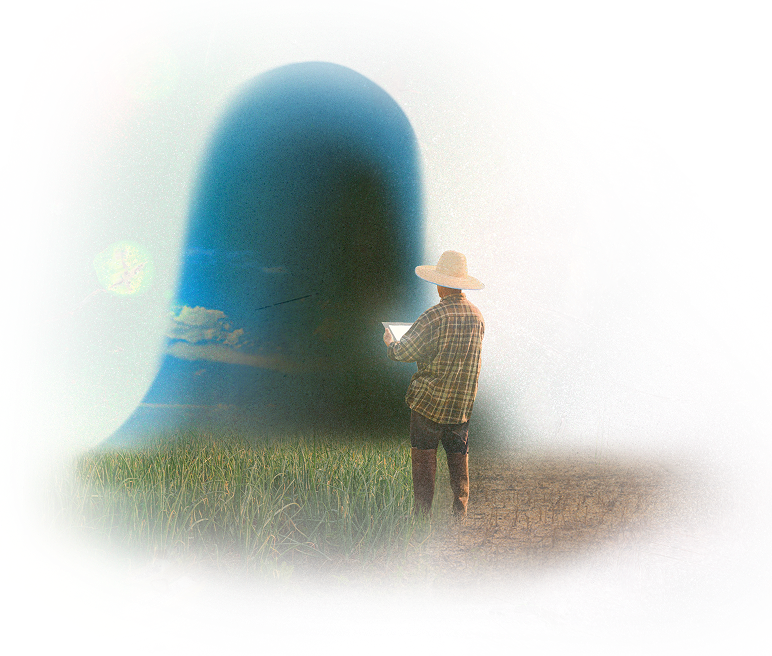
Person looking at tablet giving a glow over lush land

Today, agricultural producers must contend with unprecedented market uncertainties, input costs, weather volatility, and labor shortages. For millions of farmers, technologies that can improve their yields and reduce their vulnerabilities to these threats are critical for safeguarding their lands and their economic well-being. Precision agriculture is the data-driven practice of making timely, informed decisions at a micro scale to produce better outcomes for farm plants, animals, soils, and ultimately for farmers themselves. Innovations on farms might include

  • satellite, aircraft, and drone data to develop crop condition, soil, and yield maps;
  • on-farm cameras and vision-based sensors to monitor crop health; and
  • unmanned and computer vision-enabled farm equipment for more efficient planting, pruning, weeding, watering, and/or harvesting operations.

The Role of AI

  • AI enhances the reach of agricultural management and decision support systems, overcoming linguistic, financial, physical, or logistical barriers to deliver locally relevant, precise, and accurate information to more people—where accurate refers to the likelihood of information being correct, precise to the temporal and geographic specificity of information, and relevant to the applicability of information to the farmer's specific linguistic, logistical, and economic context.
  • AI unlocks the capacity of autonomous systems and crop monitoring technologies. Leveraging large information systems and data gathered across in-field sensors, satellite and aerial imagery, and weather forecasting, AI-enabled tools allow farmers to increasingly use real-time (or near real-time) data to support timely, informed decisionmaking. Additionally, AI-based autonomous systems support the development of wholly new technologies (e.g., laser weeding) that reduce the cost and negative environmental impacts of inputs such as herbicides.

Best Practices

Best practices call for defined data standards that incentivize safe sharing for the development of equitable, scalable modeling, as well as technology development that prioritizes applying needed solutions over building tools. AI tools will neither be as effective nor as trusted as they might be without this foundation in place.

Applications for AI

Farmer receiving AI-assisted extension services guidance

Application 1

Extension Services

Uses generative AI and local expertise to deliver tailored, on-demand agricultural guidance to farmers

Application 1

Extension Services

Uses generative AI and local expertise to deliver tailored, on-demand agricultural guidance to farmers

Millions of smallholder farmers lack access to vital information that could otherwise guide their on-farm decisionmaking. Traditional extension services that seek to empower farmers with this information can be stretched thin, with extension agents each responsible for helping thousands of farmers. The expansion of digital services is also often not enough on its own.

To overcome these barriers, AI-assisted extension services use models that can synthesize multiple inputs to deliver localized, actionable insights more quickly and affordably. Such advisory services enable more accessible (i.e., wider reaching, timelier, and linguistically-specific) digital tools to help farmers make better on-farm decisions.

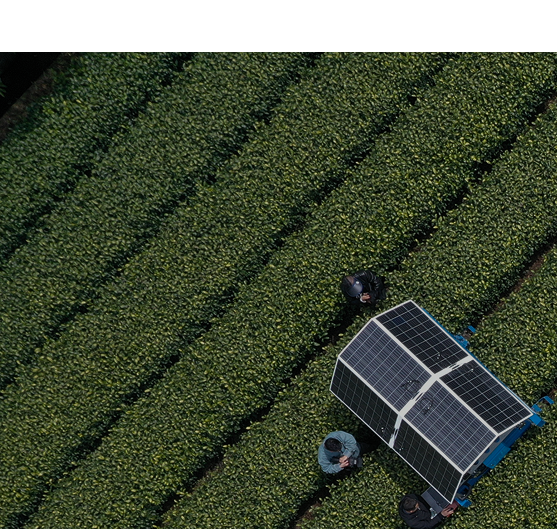
AI-assisted farm machinery and automation equipment

Application 2

On-Farm Automation and Mechanization

Uses AI-assisted machinery to support on-farm labor needs for tasks such as planting, pest and disease management, irrigation, or harvesting

Application 2

On-Farm Automation and Mechanization

Uses AI-assisted machinery to support on-farm labor needs for tasks such as planting, pest and disease management, irrigation, or harvesting

Inputs and machines that help generate greater crop yields and reduce labor burdens remain out of reach for many farmers, particularly smallholder farmers in developing contexts. At the same time, younger generations are increasingly turning away from agricultural work, and long-standing labor shortages are deepening across farming systems that depend on large, seasonally concentrated workforces.

Advancements in AI-assisted robotics and mechanization can help overcome those input and labor gaps, transforming how farm work is performed and by whom.

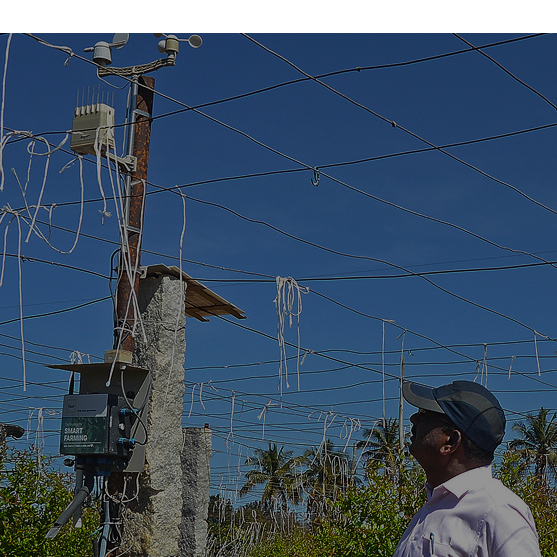
Agricultural sensors and digital monitoring devices in the field

Application 3

Agricultural Intelligence

Uses imagery and sensor data to observe on-farm conditions and inform agricultural decisionmaking

Application 3

Agricultural Intelligence

Uses imagery and sensor data to observe on-farm conditions and inform agricultural decisionmaking

Historically, farmers have relied on direct observation and lived experience to understand and anticipate their fields' conditions. With AI, digital devices and sensors can collect and interpret vast amounts of environmental and agronomic data—including rainfall, soil moisture, and crop health data—and use them to generate timely, actionable guidance. These capabilities allow farmers to see more and intervene with greater precision than ever before.

These systems feed back into multiple streams of AI-supported agricultural efforts, creating "data exhaust" that is actionable for early warning systems, extension services, and crop development alike.

This report was made possible by
the generous support of Google.org.

Research

The CSIS Global Food and Water Security Program

Acknowledgments:

CSIS also thanks all participants of the Artificial Intelligence for Food Security roundtables and the AI for Food Security Forum; with special thanks to those researchers, practitioners, and stakeholders who have contributed to the AI Collaborative: Food Security.

Image Credits:

Header Illustration: The use of AI technology helps a farmer transform barren land into a lush field. Image created by Gina Kim with assets by KDP via Getty Images and Adobe Stock.

Application 1: Stock photo of a farmer using a tablet in a cornfield. | Daniel Balakov via Getty Images.

Application 2: AI tea-picking robots wearing 'hats' made of solar panels harvests Longjing tea leaves in Hangzhou, China, in March 2024. | VCG/VCG via Getty Images.

Application 3: Farmer R. Murali looking at a waspmote device with AI sensors to access soil properties on his farm in Chikkaballapur, India, in February 2025. | AFP via Getty Images.

Story Production

The Andreas C. Dracopoulos iDeas Lab

Editorial and project oversight:

Design:

Sarah B. Grace and Gina Kim

Illustrations:

Gina Kim

Data visualizations:

Web design assistance:

Copyediting: